

Guide
What to print on a ceramic tile carton (ISO 13006)
ISO 13006, the international standard for ceramic tiles, requires tiles and/or their packaging to carry ten items: the manufacturer and country of origin, first quality, the tile type and group, the nominal and work sizes, glazed or unglazed, any surface treatment, the number of tiles, the batch, the shade and the maximum weight of the box. Ethiopia adopted the standard as ES ISO 13006.
Key facts
| The standard | ISO 13006:2018, Ceramic tiles: definitions, classification, characteristics and marking |
|---|---|
| Ethiopian standard | ES ISO 13006:2005 (Ethiopian Standards Agency) |
| Where the marking goes | On the tiles and/or their packaging |
| Items to mark | Ten, listed in clause 8.1 |
| Changes with every run | Batch and shade |
| On each tile | The country where it was made, on the back or edge |
What does ISO 13006 require on a tile box?
Clause 8.1 of ISO 13006:2018 lists the marking that tiles and/or their packaging must carry. In practice the marking goes on the carton: the fixed items are printed on it, and the items that change with each production run are stamped or labelled by the factory line.
| Item | What it means | Printed or stamped |
|---|---|---|
| Manufacturer and country of origin | Your mark or trademark, and “Made in Ethiopia” | Printed |
| First quality | The quality of the tiles in the box | Printed |
| Tile type and group | Dry-pressed or extruded, and the group and annex, e.g. Group BIa, Annex G | Printed |
| Nominal and work sizes | e.g. 60 × 60 cm (work size 598 × 598 × 10 mm), and “M” if modular | Printed or stamped |
| Surface | Glazed (GL) or unglazed (UGL) | Printed |
| Surface treatment | Any treatment applied after firing, such as a protective sealer | Printed if used |
| Number of tiles | The tiles in the box | Printed or stamped |
| Batch | The manufacturer’s production run or batch number | Stamped |
| Shade | The colour consistency, as defined by the manufacturer | Stamped |
| Maximum dry weight | The weight the tiles and packaging will not exceed | Printed or stamped |
What does a complete marking look like?
ISO 13006 gives worked examples. One, for a porcelain floor tile, reads: “The 123 Tile Co., Made in Spain, Ceramic Tile of First Quality. Dry-pressed porcelain tile, ISO 13006:2018, Annex G, Group BIa, Rectified. 60 cm × 60 cm (Sw 598 mm × 598 mm × 10 mm) UGL. 3 pcs/box, batch B52, 0590-Slate, Max dry weight: 16 kg.” For an Ethiopian factory, the same marking names your company and “Made in Ethiopia”. The standard also asks that each tile shows the country where it was made on its back or edge.
Why do the batch and the shade matter?
Tiles from different production runs can differ slightly in colour and size, so installers lay a floor from boxes of the same batch and shade. That is why these two items should be easy to read on the end of the carton, where boxes stacked on a pallet or a shop shelf can be checked without moving them.
How should the carton be designed around the marking?
Plan the marking with your carton maker before the artwork is final.
- Print the fixed items (your mark, origin, first quality, tile type and group, surface) on the carton.
- Leave a clear, light panel on each end for the batch, shade, size and count your line stamps or labels.
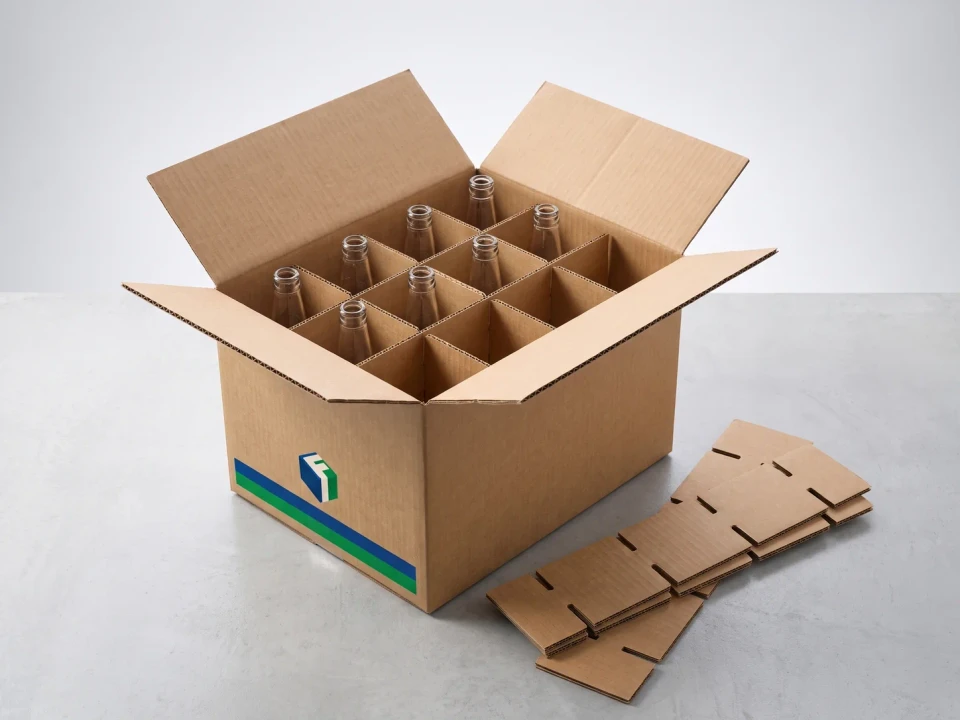
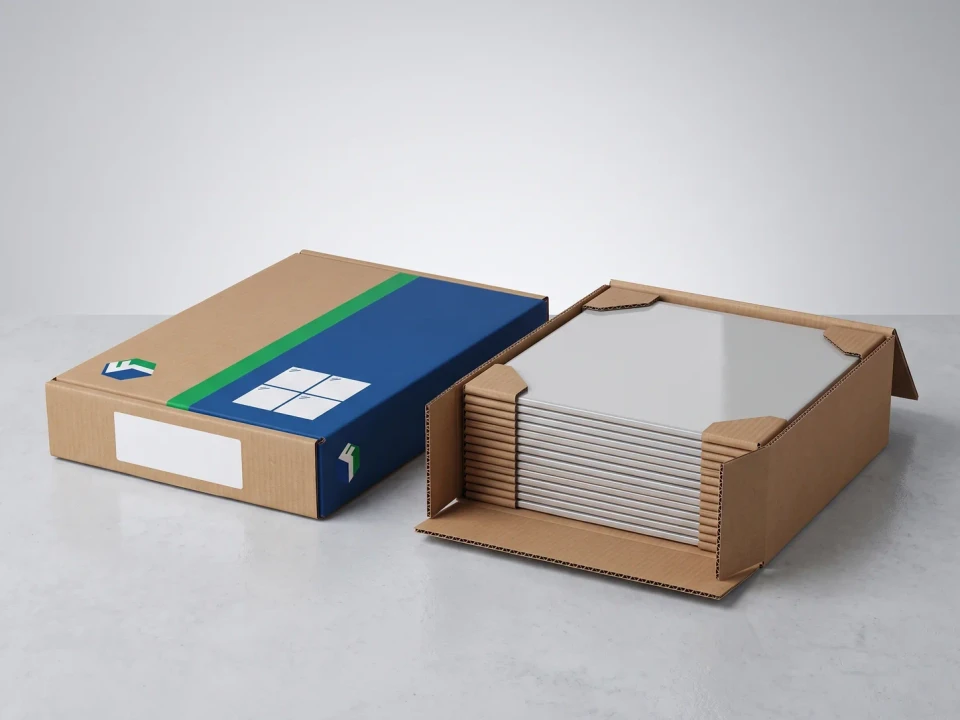
- Size the carton to the tiles and the count, so nothing moves and edges cannot chip.
- Choose the board for the full box weight and the stacking height on the pallet.
- Show the maximum weight clearly: tile boxes are lifted by hand on site.
How strong does a tile carton have to be?
Strong enough for a heavy, dense load. The examples in ISO 13006 give maximum box weights of 16 to 20 kg, and boxes of large floor tiles are often heavier. The carton should fit tightly, because tiles that can move chip their edges, and the board is chosen for the box weight and how high boxes are stacked. For export, allow for the road or rail journey to Djibouti and for sea freight.
Questions
Does the marking go on the tile or on the box?
ISO 13006 allows either: the marking is required on “tiles and/or their packaging”. In practice it goes on the box, and each tile shows only the country where it was made, on its back or edge.
What do GL and UGL mean on a tile box?
GL means glazed and UGL means unglazed. The nature of the tile’s surface is one of the items ISO 13006 requires in the marking.
What is the difference between nominal size and work size?
The nominal size describes the tile, such as 60 × 60 cm. The work size is the size it is made to, such as 598 × 598 × 10 mm. ISO 13006 asks for both on the marking.
Sources
- ISO 13006:2018 Ceramic tiles: definitions, classification, characteristics and marking · International Organization for Standardization (ISO), 2018
- ISO 13006:2018 preview, clause 8 Marking and specifications · iTeh Standards, 24 Sep 2026
- Ethiopian Standards catalogue 2021 (ES ISO 13006:2005) · Ethiopian Standards Agency, 2021